I just read my first blog and all I have to say is I was an idiot. I don't know if I thought I was too stubborn and set to change much or if I just didn't know how to or didn't want to say it in a blog the first week we were here. ha this experience has done so much more for me than make me miss taco bell. All the history and culture I absorbed in the last 2 months is irreplaceable and irreplicable. I learned so much that I could never have gotten from sititng in a classroom, "learning" from a book I refused to pay $200 for, in Ohio no less. I LIVED in Italy for 2 months and if not for being here I may have not been able to go all the other places I went as well. I have wanted to go to Auschwitz since I was in 4th grade and first learned about the Holocaust. Thanks to this trip I am a well traveled person!
I learned that I love mojitos and there are a lot of people who hate fish haha
I learned so much about myself that I never thought possible. I never wanted to be one of those "I found faith in Italy" type people, or better yet I never, ever thought I would hear myself say that or even think it. But I really did. Though my thoughs and beleifs may still be off the beaten path, I actually know what I believe now and I think it took being here now with these specific people to do that for me. I don't believe for a second that it is coincidence that we are all here because we all have so much to offer each other specifically. We fit together like lattice tilings!! haha Of course we all know The Shack helped pave my path to my new understanding and I still insist you all read it. We will pass it around!
As important as all that is, I think it's most important that I learned so mcuh about so many amazing people. I'm not tryin to get all mushy gushy in a blog, but you are all amazing people with so much to offer the world and I am going to miss every single one of you verrrrrry much. It really isn't about what you know, it's all about who you know. We are always saying "we know Danilo!" and that obviouisly gets us pretty far here. But I think you can know everything there is to know about everything, but without someone to share it with, it's nothing. <3
Friday, October 9, 2009

the final final...
A lot of math goes into a lot of things that we see or do every day without us having any idea. I was surprised when I learned about the flower petals being in Fibonacci patters and that music is mathematically composed. However I was intrigued when I realized there is a mathematical sequence behind tiling. The tiles I walk on and see everywhere on a daily basis are arranged according to mathematical law. It seems so simple and it makes sense after all they are composed of geometrical shapes which normally would trigger the math light bulb in my head. For whatever reason it seems tiling escaped that thought process.
Tiling by definition is the covering of an entire plane with non overlapping figures. The key to tiling, as laid out by St. Thomas Aquinas, is symmetry. All that really means is that the proportions of the images you are looking at should be equal or mirrored. This component makes the tiling pleasing to the eyes and allows things to fit together in a way that is orderly and makes sense. Ceramic is the most common material used to create tiles and has been being used by man to create decorative or practical tiles for 4000 years. Decorative tiling can be found in ruins and different buildings all around the world. They were first made by hand and laid out to bake in the sun and remained flat. They could then paint them to make them more appealing. After a while they were able to make a mold out of wood that would help make a consistent size, shape and patter on each tile. The manufacturing and decorating of the tiles was perfected during the Islamic period in Persia.
Now-a-days we have machines to do all the making and painting of the tiles that we use all over the place. The most common patter is monohedral which uses only one shape and size of tile. It’s common to find tiling like this in practical places like many kitchens and bathrooms. These tiles and many others are considered edge-to-edge because they share a side with the next tile as opposed to being a free shape. In the 1970’s Sir Roger Penrose developed the Penrose tiling which is non-periodic, meaning there is not repetition within the pattern. These types of tilings seem to remind me of a flower usually and often take up larger spaces. We see a lot of frieze patterns in the museums and buildings we visit in Italy. This type of tiling is not meant to fill a plane like a floor or a wall, but is instead used as borders to other planes and/or materials. My personal favorite type of tiling was developed by M.C. Escher as a result of his study on the Regular Division of the Plane. It is called lattice tiling and can contain pretty much any pattern you can imagine. When the individual tiles come together at the sides they fit together like a puzzle piece in order to complete their shape. I read in multiple articles that Escher was known for his eye for abstract beauty. My favorite was one that said he “likes to challenge the logic of seeing.” He would sit there and draw random animals and people interlocking in every way possible until he could come up with an infinite pattern with aesthetic value and after 40 years of practice he mastered his obsession.
The first example of complex semi-regular tiling that comes to mind is the tilings we saw in the Vatican museum on the floors. They are from all over the place, brought to the museum not just to cover the floor but to be on display. They were there and we saw them but I don’t know that we were able to appreciate their worldly value. They create a mosaic picture which in some cases which can tell a story just as much as the statues and paintings in the room around it. Not to mention the fantastic colors and patterns created even without a picture. Just about every church and museum we have visited has had a wide variety of tilings on display that I feel often get over looked because we are so focused on looking up. I think from now on I will take a second to look down at the patterns in the floor or on the walls or borders as well as the art in the vicinity.
Tiling by definition is the covering of an entire plane with non overlapping figures. The key to tiling, as laid out by St. Thomas Aquinas, is symmetry. All that really means is that the proportions of the images you are looking at should be equal or mirrored. This component makes the tiling pleasing to the eyes and allows things to fit together in a way that is orderly and makes sense. Ceramic is the most common material used to create tiles and has been being used by man to create decorative or practical tiles for 4000 years. Decorative tiling can be found in ruins and different buildings all around the world. They were first made by hand and laid out to bake in the sun and remained flat. They could then paint them to make them more appealing. After a while they were able to make a mold out of wood that would help make a consistent size, shape and patter on each tile. The manufacturing and decorating of the tiles was perfected during the Islamic period in Persia.
Now-a-days we have machines to do all the making and painting of the tiles that we use all over the place. The most common patter is monohedral which uses only one shape and size of tile. It’s common to find tiling like this in practical places like many kitchens and bathrooms. These tiles and many others are considered edge-to-edge because they share a side with the next tile as opposed to being a free shape. In the 1970’s Sir Roger Penrose developed the Penrose tiling which is non-periodic, meaning there is not repetition within the pattern. These types of tilings seem to remind me of a flower usually and often take up larger spaces. We see a lot of frieze patterns in the museums and buildings we visit in Italy. This type of tiling is not meant to fill a plane like a floor or a wall, but is instead used as borders to other planes and/or materials. My personal favorite type of tiling was developed by M.C. Escher as a result of his study on the Regular Division of the Plane. It is called lattice tiling and can contain pretty much any pattern you can imagine. When the individual tiles come together at the sides they fit together like a puzzle piece in order to complete their shape. I read in multiple articles that Escher was known for his eye for abstract beauty. My favorite was one that said he “likes to challenge the logic of seeing.” He would sit there and draw random animals and people interlocking in every way possible until he could come up with an infinite pattern with aesthetic value and after 40 years of practice he mastered his obsession.
The first example of complex semi-regular tiling that comes to mind is the tilings we saw in the Vatican museum on the floors. They are from all over the place, brought to the museum not just to cover the floor but to be on display. They were there and we saw them but I don’t know that we were able to appreciate their worldly value. They create a mosaic picture which in some cases which can tell a story just as much as the statues and paintings in the room around it. Not to mention the fantastic colors and patterns created even without a picture. Just about every church and museum we have visited has had a wide variety of tilings on display that I feel often get over looked because we are so focused on looking up. I think from now on I will take a second to look down at the patterns in the floor or on the walls or borders as well as the art in the vicinity.
Thursday, October 8, 2009
birth-day-cake! birth-day-cake! =)
There were only a few paintings in the Palazzo Barberini that were off on their linear perspective and even fewer that were obvious or that I was certain about. You basically had to walk in circles, upside down and side ways to see where the malfunction was. However now that I know what to look for I’m always going to be looking for inconsistencies in paintings. The painting I chose is one I would imagine a lot of people did because once you realized the problem, it stuck out like a sore thumb. In Tinoretto’s “Christ and the Adulteress” the linear perspective is all messed up. The first thing that I was able to pin point was the columns. Especially if you stand to the right of the painting you can see that the rows of columns were not straight at all. They are all heading to different places which made me really dizzy if I looked at it for too long trying to figure out where they were going haha. Next the tiles aren’t going in the same direction as the columns, specifically the first row of columns after the vault. This row appears to be pointing in a different direction than the blue and white tiles. This is made even more obvious by the vault which is pointing straight ahead. Have you ever seen a building whose ceiling pattern is straight, the columns pointing in a different direction as well as not uniform and the floor patter pointing another way? Probably not unless you were in a fun house ha. I do have to say that it makes the painting a little fun because it’s all messed up. I actually liked it more once I realized it was all wrong.
Sunday, October 4, 2009
Art Final ... yes.. I said FINAL =S
We have seen more art over the last 7 weeks than I would be willing to almost guarantee I have seen in the previous 20 years combined. We have seen works from all the big, world renowned artists such as Raphael, Michelangelo, da Vinci, and Donatello (the Turtles I call them) to works by artists that were unknown and will remain that way. One statue that keeps coming to the surface of my pool of thoughts about artwork is The Belvedere Torso which we saw in the Vatican Museum. The date it was originally discovered is unknown, well uncertain; however knowledge of it began to surface in the 1430’s. By 1500 it was a well known construction of interest. Originally it was believed to be an original sculpture from the 1st century BC, but now is believed to be a recreation of an older construction from approximately the 2nd century BC. Although there are many theories as to where or why the sculpture originated one thing that is apparently certain is the sculptor himself. He made it a point to blatantly sign his work ‘Apollonius, son of Nestor, Athenian’ but nothing is actually known about him or the purpose of his work. Some scholars believe that his signature can be found on other works from the same projected time, however I have found that of all that believe this, just as many scholars disagree.
Just as Leonardo said in our tour of the Vatican Museum, one of the most popular candidates for the whole of the original statue is Hercules due to its proportion and muscularity. It was thought that it was intended to be Hercules sitting on the skin of the Nemean Lion but after further research it was found that if it is indeed an animal hide then it’s consistent of panther, not lion. It was always just sort of assumed that it was the mighty Hercules, but if the skin is of a panther then it doesn’t really make any sense for it to be Hercules. The newer theories are that it may be Polyphemus or Marsyas or even still Hercules, but we can never really know who or what Apollonius, son of Nestor intended. For all we know he could have made it the way it appears today as a joke. How hilarious would that be?
It is also important to note that ‘The Torso’, as it has come to be known, can be seen rather obviously in Michelangelo’s painting on the ceiling of the Sistine Chapel. The Torso was inspiration for many artists who attempted to recreate or sketch it. I can relate to this because my imagination is inspired when I look at this sculpture. Not knowing exactly who or what it is makes my little brain just go crazy. I try to picture the completed statue in so many different ways. I have seen it with a head and arms that bear a striking resemblance to my Papaw then a minute later I imagine a goat head and something like monkey arms or duck feet. As outrageous as that sounds, it’s not completely impossible and I have an outrageously vivid imagination so I can actually picture it like that. I am always looking for reasons why and explanations for those things that can’t be or haven’t been explained no matter how nonsensical my fabricated explanations may be. I assume that is why I am so drawn to The Torso, because it lets my imagination go wild instead of having a concrete (or marble in this case) story or explanation. It’s mysterious and powerful because no person can say they know everything about it. It more or less can’t be beaten by even the most knowledgeable human on earth and to me that is absolutely beautiful.
Just as Leonardo said in our tour of the Vatican Museum, one of the most popular candidates for the whole of the original statue is Hercules due to its proportion and muscularity. It was thought that it was intended to be Hercules sitting on the skin of the Nemean Lion but after further research it was found that if it is indeed an animal hide then it’s consistent of panther, not lion. It was always just sort of assumed that it was the mighty Hercules, but if the skin is of a panther then it doesn’t really make any sense for it to be Hercules. The newer theories are that it may be Polyphemus or Marsyas or even still Hercules, but we can never really know who or what Apollonius, son of Nestor intended. For all we know he could have made it the way it appears today as a joke. How hilarious would that be?
It is also important to note that ‘The Torso’, as it has come to be known, can be seen rather obviously in Michelangelo’s painting on the ceiling of the Sistine Chapel. The Torso was inspiration for many artists who attempted to recreate or sketch it. I can relate to this because my imagination is inspired when I look at this sculpture. Not knowing exactly who or what it is makes my little brain just go crazy. I try to picture the completed statue in so many different ways. I have seen it with a head and arms that bear a striking resemblance to my Papaw then a minute later I imagine a goat head and something like monkey arms or duck feet. As outrageous as that sounds, it’s not completely impossible and I have an outrageously vivid imagination so I can actually picture it like that. I am always looking for reasons why and explanations for those things that can’t be or haven’t been explained no matter how nonsensical my fabricated explanations may be. I assume that is why I am so drawn to The Torso, because it lets my imagination go wild instead of having a concrete (or marble in this case) story or explanation. It’s mysterious and powerful because no person can say they know everything about it. It more or less can’t be beaten by even the most knowledgeable human on earth and to me that is absolutely beautiful.
Thursday, October 1, 2009
Your peeps aren't Caths?
Out of all the structures we saw by Bernini on our walking tour, I chose the “Fountain of the Rivers” located in the center of Piazza Navona to investigate further. It was commissioned by Pope Innocent X whose crest can be recognized between what I believe to be the Ganges and Danube rivers and the Papal family Pamphilj in 1648. It’s constructed of marble and travertine. The purpose projected by the Pamphilj family was to demonstrate the church’s influence and power about the four existing regions of the world, thus demonstrating the universal nature of the church. Each river is identified by a person who was never a real figure. This person is a personification of one of the then known four continents which is associated with each particular river. The rivers are The Danube (Europe), The Ganges (Asia), The Rio della Plata which is personifies the riches of the Americas with coins and a black man. The most interesting to me is the depiction of the Nile because it is depicted by a man with a covered head because at this time Europeans didn’t know where the Nile came from, so they had no way to personify something they didn’t know anything about.
There are some interesting symbolic factors to this fountain as well that I would never have noticed or recognized without digging deeper. For example, there is a bronze pigeon at the top of the fountain that represents the transcendental peace of the church over the whole world or the world as they knew it. It is not a secret that Bernini and Borromini were not on good terms. There are theories that suggest that the rivers of Rio della Plata and the Nile were placed facing the Church of Sant’Agnese in Agone which was by Borromini. The hand of the personification of the Rio della Plata has a hand raised at the church supposedly to shield himself from the collapse of the church suggesting instability and faulty work by Borromini. It is also suggested that the personification of the Nile has his face covered not because they didn’t know where the Nile came from, but because he was refusing to look at the work of Borromini. Which I think is pretty funny ha.
There are some interesting symbolic factors to this fountain as well that I would never have noticed or recognized without digging deeper. For example, there is a bronze pigeon at the top of the fountain that represents the transcendental peace of the church over the whole world or the world as they knew it. It is not a secret that Bernini and Borromini were not on good terms. There are theories that suggest that the rivers of Rio della Plata and the Nile were placed facing the Church of Sant’Agnese in Agone which was by Borromini. The hand of the personification of the Rio della Plata has a hand raised at the church supposedly to shield himself from the collapse of the church suggesting instability and faulty work by Borromini. It is also suggested that the personification of the Nile has his face covered not because they didn’t know where the Nile came from, but because he was refusing to look at the work of Borromini. Which I think is pretty funny ha.
Monday, September 28, 2009
No detouring from MY tour!
Italy is known for a wide variety of it's qualities. However, it's safe to say that the food is near the top of that list. Personally the awesome food was one of the things I was looking most forward to on a daily basis so it makes sense that my walking tour is focused on food. It's no secret that I l-o-v-e to eat. Rome is a pretty large and diverse place. There are a lot of places to eat with different scenery and their own qualities but the piazzas jump out at me as a top place to get fill of some good food and good people. You can observe the Italian culture at work in and around most of these places. I'm most intrigued by Piazza Navona and the Campo de Fiori probably because of all the people and variety of everything you can find in these places. The destinations I have chosen circle around the Piazza Navona and the Campo because I consider them to be two of the most awesome homegrown Italian places that we walk through all the time, but always for a purpose, never just to stop and smell the roses or relax.
We begin in the Campo de Fiori...
We begin in the Campo de Fiori...
- "La Carobonara" was opened first in 1912 and provides a unique panorama of all of Campo de Fiori. They feature indoor and outdoor seating for a private, more ellegant dining experience or for some ultimate people watching.
Now we travel out of the Campo towards Corso Vittorio Emanuele II through the Piazza della Cancellerina. (Watch out crossing the C.V.E II! Those Italians and their Vespas..) Pass through the Piazza s. Pantaleo onto Via di Santa Maria dell'Anima where you can find all kinds of restaurants and cafe's, but they are pretty much your standard sit and eat places. None that really jumped out at me. So you take this street all the way to Largo Febo...
- "Ristorante Santa Lucia" is tucked back in a corner with a dining area just above Via di Santa Maria dell'Anima. They have an ellegent outdoor setting until winter and an impressive selection of some rather expensive food. The average cost of just the main course was 28 Euros with the most expensive being around 35 Euros. The dining square is up high enough that you can get a glimpse of Italy at work or leisure while enjoying the authentic Italian cuisine from a comfortable setting.
Now we take a right into Pazza Navona which to me embodies the essence and root of Italian culture. It was important a long time ago as a circus which was an important cultural center and now serves as the classic example of Italian culture. All the restaurants in the Piazza are worth while, but the ones I chose are all tied together by the Piazza and it's activities. Upon entering the Piazza on your left you will find...
- "Domiziano" which is at the head of the Piazza where you can clearly see everything going on all over the place. It would be a great place to just sit and talk or watch the hustle bustle of the people around the Piazza. Another reason I liked this place is because all the people I observed or talked to in this particular restaurant didn't speak much english if any at all. It really reminded me that I'm actually completely emersed in the heart of Italian culture because I'm so used to more or less being able to get my point across in english almost everywhere we go.
Now continue through the Piazza keeping on the left side.On your right you can see an innumerable amout of people selling various products or talents and all kinds of people from all walks of life gathering for whatever reason. All the hardcore classic Italian chitter chatter can be picked up on here. You know, the kind that even some Italians need a translator to understand because of the strong accents and Speedy Gonzalas pace of conversation. On the left near the center...
- "Don Chisciotte" has pretty much everything you could possibly want to eat without completely breaking the bank. It was by no means cheap in the eyes of a college student, but for those looking for a moderately priced meal with a variety of Italian cuisine, this is the place to go. Near the heart of the Piazza, it gives you a front row seat to the events taking place in the Piazza. Another plus to this particular restaurant was that the guy I was talking to pointed out the Alfredo as a favorite before I even got excited about it being on the menu. They weren't pushy or rude like a lot of people can be when they really want you to sit at their restaurant.
Now you keep heading straight out of the Piazza on the left side down Via della Cuccagna after taking in the sights and sounds of the heart of Piazza Navona, it's statues and inhabitants to find...
- "La Piccola Cuccagna dal 1950" which means "the small land of plenty". It was established in 1950 and features a menu for those looking to get a taste of a variety of Italian cuisine in one sitting without the entire meal for 18 Euro. Just outside the Piazza, there is a constant flow of people coming and going, chitting and chatting. It's also a little dark in this small Via at most points of the day, so the Piazza serves as almost a light at the end of the tunnel and can be viewed from the dining area of this "small and of plenty."
We now venture back across Corso Vittorio Emanuele II back into Campo de Fiori. In the far back right corner you will find my favorite of the tour and most odd for the area it's situated in...
- "The Drunken Ship" serves a variety of food from American cuisine to traditional cheese platters found only in Italy. You can experience the best of both worlds, as they really are two completely different worlds in my eyes. Not to mention a front row seat to the show we know as Campo de Fiori and a spicy night life after the market closes down. They convert from a casual dining experience to a hoppin' bar at night where you will discover their slogan is "Get Ship Faced." I'm sure you can imagine I find this utterly amusing.
This concludes my tour of "Eating Rad in Rome" with 5 unique restraunts all tied together by the Piazza Navona and Campo de Fiori and the people/activities that make them the cultural centers they have come to be. Not to mention some awwwwwesome food!!
Thursday, September 24, 2009
Ahhh Ewwwww!!!!!...what are we 'ewwing'?
Even though the term Catholic means universal, there are some things about the church that I was able to pick out in St. Peter's Basilica that were a direct Roman influence as well as somethings that applied to or were influenced by people all over the world. To begin with the artwork within the church is Roman. If you were to go to Spain or France or anywhere else in the world the artwork and decorations would be slightly different because of the different styles from each region. St. Peter's specifically is hardcore Roman because of it's direct tie to the Vatican and the Vatican's direct tie to Rome. Whenever I think "Vatican" the following thoughts are always "Catholic, Pope and Rome." The way I see it, Rome is one of the oldest cities on earth and the Catholic church is pretty dang old obviously. So these reallllllly old churches like the Pantheon are Roman because they are so old not to mention in the Pantheon's case there are important Roman figures tombs located within it.
I see the universalness (I make up words) in the simple Catholic nature of the churches. Not to mention that no matter what faith you follow, a church is still a gathering place for believers which makes it universally appealing. The statues and paintings of Saints seem universal to me because the Saints aren't just Roman but they are a Catholic thing more or less. I'm having trouble spitting out what I'm trying to say. Basically all the basic religious stuff is universal for anyone because it's all about the life and sacrifice of Jesus. So whether you believe he was a prophet or the Son of God or just a cool dude who spread some good ideas, you still appreciate his having existed whether you live in Rome, Italy or Rome, Ohio.
I see the universalness (I make up words) in the simple Catholic nature of the churches. Not to mention that no matter what faith you follow, a church is still a gathering place for believers which makes it universally appealing. The statues and paintings of Saints seem universal to me because the Saints aren't just Roman but they are a Catholic thing more or less. I'm having trouble spitting out what I'm trying to say. Basically all the basic religious stuff is universal for anyone because it's all about the life and sacrifice of Jesus. So whether you believe he was a prophet or the Son of God or just a cool dude who spread some good ideas, you still appreciate his having existed whether you live in Rome, Italy or Rome, Ohio.
Monday, September 21, 2009
MiDtErM
http://www.penwith.co.uk/artofeurope/bosch_garden_earthly_delights.jpg
^^^Check it out here!!!!^^^ =D
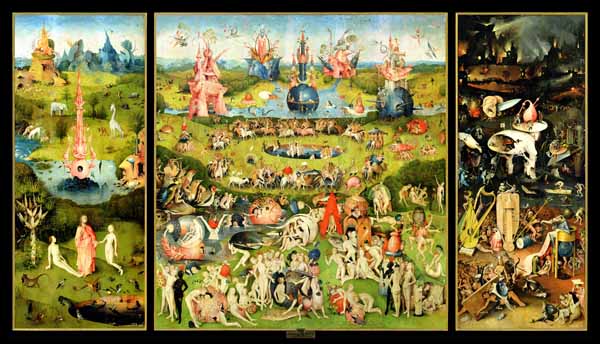
The piece of artwork I chose is “The Garden of Earthly Delights” by Hieronymus Bosch. He painted this awesome triptych during 1503-04 and is now housed in the Museo del Prado in Madrid, Spain since 1939. Its dimensions are 87 in. by 153 in. and is a three paneled oil and wood triptych.
I have always been drawn to this painting basically because it is so weird. Especially to have been painted in the early 1500’s when Bosch was in his 50’s it seems like it would have been a more modern painting for that time. The use of color and abstract figures is something I would expect for myself or someone my age to paint now. The left panel of the triptych is (or is thought to be) a depiction of the beginning of creation. All the important figures are represented, specifically the concrete figures of the creation story, Adam and Eve. The middle panel is large in comparison to the other two and is just a mess when you first look at it. There is a little bit of everything going on. The most obvious thing is all of the naked people doing whatever they may be doing. Also they all appear to be rather young. Some people speculate that this may be Bosch’s interpretation of the sinfulness of the world after creation or that it may be a depiction of the paradise we lost with the fall of man. Whatever it was meant, it is really cool and keeps me entertained. I am always trying to figure it out and making up little stories about all the people and why they look the way they do or why they are doing whatever they are doing. The panel on the right is hell. There isn’t really any other way to interpret it especially if you get the correct imagery out of the first two panels. It is thought to be Bosch’s depiction of what happens when humans fall to temptation. The city is even burning, it’s obviously hell.
My first impression of this particular piece was just that I loved it. Then after learning a little bit about it I just agreed with the background I had been given about it being creation and earth and hell. Then upon putting more thought into it, my own interpretation, I should say my next guess, would be that the left panel is good, the right panel is evil and the middle panel is the struggle between the two. You can see in the middle panel some solo people looking out on the crazy other people and I can imagine them being unsure what to think about the things going on around them, trying to figure out what is right for them or where they stand. I consider it more a portrait of humanity and temptation than a temptation to hell type scenario. Although traditionally triptychs are meant to be “read” from left to right and Bosch’s other two triptychs are “read” from left to right, that doesn’t mean this one necessarily had to follow the pattern. Even though it probably does, I still like my interpretation not completely ruling out the expert’s opinions. It’s good to break the mold every now and then!
^^^Check it out here!!!!^^^ =D
The piece of artwork I chose is “The Garden of Earthly Delights” by Hieronymus Bosch. He painted this awesome triptych during 1503-04 and is now housed in the Museo del Prado in Madrid, Spain since 1939. Its dimensions are 87 in. by 153 in. and is a three paneled oil and wood triptych.
I have always been drawn to this painting basically because it is so weird. Especially to have been painted in the early 1500’s when Bosch was in his 50’s it seems like it would have been a more modern painting for that time. The use of color and abstract figures is something I would expect for myself or someone my age to paint now. The left panel of the triptych is (or is thought to be) a depiction of the beginning of creation. All the important figures are represented, specifically the concrete figures of the creation story, Adam and Eve. The middle panel is large in comparison to the other two and is just a mess when you first look at it. There is a little bit of everything going on. The most obvious thing is all of the naked people doing whatever they may be doing. Also they all appear to be rather young. Some people speculate that this may be Bosch’s interpretation of the sinfulness of the world after creation or that it may be a depiction of the paradise we lost with the fall of man. Whatever it was meant, it is really cool and keeps me entertained. I am always trying to figure it out and making up little stories about all the people and why they look the way they do or why they are doing whatever they are doing. The panel on the right is hell. There isn’t really any other way to interpret it especially if you get the correct imagery out of the first two panels. It is thought to be Bosch’s depiction of what happens when humans fall to temptation. The city is even burning, it’s obviously hell.
My first impression of this particular piece was just that I loved it. Then after learning a little bit about it I just agreed with the background I had been given about it being creation and earth and hell. Then upon putting more thought into it, my own interpretation, I should say my next guess, would be that the left panel is good, the right panel is evil and the middle panel is the struggle between the two. You can see in the middle panel some solo people looking out on the crazy other people and I can imagine them being unsure what to think about the things going on around them, trying to figure out what is right for them or where they stand. I consider it more a portrait of humanity and temptation than a temptation to hell type scenario. Although traditionally triptychs are meant to be “read” from left to right and Bosch’s other two triptychs are “read” from left to right, that doesn’t mean this one necessarily had to follow the pattern. Even though it probably does, I still like my interpretation not completely ruling out the expert’s opinions. It’s good to break the mold every now and then!
Sunday, September 20, 2009
"Jesus was like WebMD"
Music has always been something that I pay a lot of attention to. I literally like everything from Bach to Taylor Swift to Eminem to Def Leppard and everything in between. I love the stories and meanings that the songs tell or portray. When we were sitting in class I was thinking "oh crap now that I know there is math involved in music it's goin to screw it all up". Then of course I came back to the computer lab, listened to my music and not a thing changed. I still listen to the music for what it is saying to me instead of the measurements and chords and so on that went into it's production. Even classical music has a story. I have a very vivid imagination and inside my silly lil head there is always a little movie goin along with the music. I wanted to wait to write my blog until after we went to the concert on Thursday to see if I thought about the math involved. Instead I saw little bunnies in my head running around like maniacs. ha So basically, thank goodness, my view of music hasn't been altered now that I know that there is math involved in making it happen.
Wednesday, September 16, 2009
Out of control
How weird is it that the Via Giulia is 500 years old and that sounds young to me in comparison to the 2,000 year old places we have encountered? Just needed to throw that out there. I really liked the way the street was put together. It didn't seem as confusing as other places we have been like Venice and Florence with their curvy, confusing, messed up streets. There also is a variation of buildings with various purposes. All the shops aren't just in one place and all the houses aren't just in one place. It's cool how it switches it up. I was expecting a bunch of old and decrepit things so all the old stuff didn't look out of place to me. However there were some things like the scaffolding, condom posters and skulls on the church that kinda threw me off. It's safe to say that the scaffolding and condom posters weren't things that the builders of the Rennaisance had access to or intended to be viewed in the Via Giulia. The skulls on the church were just unexpected and threw me off in general. Also I highly doubt that the inhabitants of the Rennaisance Era found graffiti to be an appropriate use of time. haha
Tuesday, September 15, 2009
That monkey thinks he's a kangaroo!
When I think of leisure the first thing that comes to mind is fun. Then I take into account what exactly constitutes fun? It's different for everyone right? To some people walking around a botanical garden for hours is fun, but for me very few things excite me as much as going to the zoo. =) In America fun amost always takes up time and usually a lot of it. On top of taking up time, we always feel like we don't have enough time in the day to do all the things we want to do or even feel we need to do. Next comes the stress and so on and so forth which completely counteracts the point of fun or leisure. Sports are considered leisure to us, yet games are always scheduled and highly competetive. My senior year of high school I went to school from 7 am to 1, went to work from 1-2:30 setting things up for later, then soccer from about 3-5, then back to work until about 9:30 and home to do whatever else I needed to do. Luckily for me I loved my job, but for most people that would be absolutely ridiculous. Our whole lives are scheduled out including time for leisure which isn't even really leisure anymore.
In Italy the pace is much, much slower and relaxed. There are always people talking and relaxing because they allow time for it. Instead of scheduling everything out and having a set time to do this and do that, they leave their day a little more open so they can enjoy it instead of rushing through it. Instead of working our standard 8 hrs or more consecutively during the day they work for a while, close around noon, enjoy this thing we call leisure and a huge, delicious meal, then return to work around 3 or 4 or 5. The focus more on their family as well. When I am relaxing or having the most fun it seems my friends come to mind. I don't spend much time with my family because we re al lso spread out and not as close knit as Italian families. It also seems like they know their family so much better than we know ours. I couldn't tell you anything about my grandma or grandpa's brothers or sisters. I feel like here they keep in close contact with all their family basically coining the idea of the 'big italian family'. Comparing the two persepectives it seems to me that Italians have a better appreciation for family for sure and maybe even each day than Americans tend to. They value their family enough to take whole chunks out of each day to be with them. I went from Christmas to spring break this passed year without seeing my Mom or Dean even once. They also take each day as it comes and enjoy it while it's here. Maybe we could learn something from them and take time to "stop and smell the roses" or if you're in Florence you can smell the leather, which ever you prefer. ha
In Italy the pace is much, much slower and relaxed. There are always people talking and relaxing because they allow time for it. Instead of scheduling everything out and having a set time to do this and do that, they leave their day a little more open so they can enjoy it instead of rushing through it. Instead of working our standard 8 hrs or more consecutively during the day they work for a while, close around noon, enjoy this thing we call leisure and a huge, delicious meal, then return to work around 3 or 4 or 5. The focus more on their family as well. When I am relaxing or having the most fun it seems my friends come to mind. I don't spend much time with my family because we re al lso spread out and not as close knit as Italian families. It also seems like they know their family so much better than we know ours. I couldn't tell you anything about my grandma or grandpa's brothers or sisters. I feel like here they keep in close contact with all their family basically coining the idea of the 'big italian family'. Comparing the two persepectives it seems to me that Italians have a better appreciation for family for sure and maybe even each day than Americans tend to. They value their family enough to take whole chunks out of each day to be with them. I went from Christmas to spring break this passed year without seeing my Mom or Dean even once. They also take each day as it comes and enjoy it while it's here. Maybe we could learn something from them and take time to "stop and smell the roses" or if you're in Florence you can smell the leather, which ever you prefer. ha
Sunday, September 13, 2009
Ugh.. not right now! We are getting our picture painted!
The middle ages art piece I chose to blog was a fresco type thing called Assumption of the Virgin (1489-1492) located in the Santa Maria Sopra-Minerva church. The church is full of little cove like rooms with awesome statues and frescoes. This particular one stuck out to me because it reminded me of my favorite painting, The Garden of Earthly Delights. It is a little random looking. Some of the angels are doing weird things and making funny faces with random little other things mixed in. The colors also stood out to me. Instead of being mostly brown, tan and white like it seems a lot of the paintings consist of, there is a lot of blue and green. The red clothing is what really catches your eye though. The faces look realistic but the focus of the painting is in the middle and significantly larger than the rest of the characters involved. It really sticks out to me out of all the 1874179231764 frescoes we have seen in the last 5 weeks. Basically.. its sweet!
We are golden
Needless to say I needed to do a little research on old Tom Tom after our little adventure to find some cool stuff to blog about. For whatever reason when we were visitng Fossanova I was really intrigued by the little room he died in. It was like a shoe box! Then I began wondering how he died. My vivid imagination started making up all these fun little stories explaining the death of St. Thomas Aquinas. The best one I came up with involved his sister who lived in Fossanova, her husband, and murder. Exciting. So I started researching how he died and in just about everything it says his cause of death is "unknown" which is really lame. Then I found in an article about him that says that Dante is convinced that he was murdered, poisoned even. Other important people even coroborate this story. The things that make him such a big deal would stir controversy now. The whole more or less combining of theology and science topic is always a touchy one. I can't imagine all of his ideals being well received by everyone. Certainly someone wanted to kill him right? Of course I hope he died of natural causes peacefully in his shoebox sized room, but I do love a good scandal.
Wednesday, September 9, 2009
"Then she will take a umm..what do you call it? a stink?" "huh?? You mean a drink!!"
For the record, on my paper in class I definately wrote "What is an Italian pizza, what does it do for Italian culture, and is there an American equivalent to these pizzas?" ha Just thought I would share that with you.
An Italian piazza, not to be confused with pizza, is pretty much an open area with lots of activity of various sorts. Some piazzas have historical significance like the Piazza Nuova with it's fountains that were once used as a circus. Now people from all over gather there to take pictures, eat good food, shop for cool stuff, and oogle at the street performers. It brings everyone together which is a huge part of Italian culture. They are always known for gathering to talk about everything and everything.
There are a few potetiental similar cultural structures in America. The first one that comes to mind that has absolutely no historical relevance at all is your standard mall. There are always tons and tons of people at malls--tourists, naitives you name it, they can be found in malls. They shop, eat, gather, talk, play and everything that is done in piazzas pretty much without the important background. Some malls are more well known than others such as the Mall of America just as some Piazzas are more well known. The next thing that comes to mind may just be a small town tradition thing, which gives it a little bit of history. In Marysville they always block off the center of town (Historical downtown Marysville ha) for festivals and so on. One of the big things to come through Mville is Honda's Bike Week. There is a big festival and all of downtown is closed off, stores stay open, people set up food stands and all kinds of good stuff. People come from all over the place to be there because these bikes are traveling from all over the U.S. for this festival alone. For that week downtown Marysville turns into a cultural structure similar to the traditional Italian piazza!
An Italian piazza, not to be confused with pizza, is pretty much an open area with lots of activity of various sorts. Some piazzas have historical significance like the Piazza Nuova with it's fountains that were once used as a circus. Now people from all over gather there to take pictures, eat good food, shop for cool stuff, and oogle at the street performers. It brings everyone together which is a huge part of Italian culture. They are always known for gathering to talk about everything and everything.
There are a few potetiental similar cultural structures in America. The first one that comes to mind that has absolutely no historical relevance at all is your standard mall. There are always tons and tons of people at malls--tourists, naitives you name it, they can be found in malls. They shop, eat, gather, talk, play and everything that is done in piazzas pretty much without the important background. Some malls are more well known than others such as the Mall of America just as some Piazzas are more well known. The next thing that comes to mind may just be a small town tradition thing, which gives it a little bit of history. In Marysville they always block off the center of town (Historical downtown Marysville ha) for festivals and so on. One of the big things to come through Mville is Honda's Bike Week. There is a big festival and all of downtown is closed off, stores stay open, people set up food stands and all kinds of good stuff. People come from all over the place to be there because these bikes are traveling from all over the U.S. for this festival alone. For that week downtown Marysville turns into a cultural structure similar to the traditional Italian piazza!
I have discovered that it is not just MY computer that will not let me post pictures, it's my blog in general. So while I continue to investigate and hopefully solve this malfunction I will simply have to describle the statue I chose to you in the most detail possible.
The statues and artwork of the Republican Era were used mostly for the Emperors to show how awesome they were. They were used as propaganda to make their subjects believe they should be in power. The statues of the Republican Era were built to last since it obviously was the goal of the Emperor to stay in power. However such statues were not nearly as impressive as the statues contributed by the Imperial Era. These statues were used as decoration in private residences and important places. They were meant to be pretty, not to portray or encourage a certain thought. They were often of irrelevant, however pleasing things as opposed Emperors adorned in battle garb and war scenes.
The statue I chose is of a small child not doing anything in particular but looking cute. I can imagine this statue in color in the front room of someone's house. Being the first thing you see when you enter the house, the giddy look on the child's face would be enough to make you smile. It is a copy, not an original Imperial piece. Now-a-days we would be like "what?!?! A copy!?!? Proposterous!" However during the ancient Roman times, copies were accepted just as much as the originals and held in high regard for their beauty and visual significance.
ps-if my blog disappears, don't fret. I think I may have to shut down my site completely and then re-do it so my blogs will start posting when they say they do and my pictures will load. the end.
The statues and artwork of the Republican Era were used mostly for the Emperors to show how awesome they were. They were used as propaganda to make their subjects believe they should be in power. The statues of the Republican Era were built to last since it obviously was the goal of the Emperor to stay in power. However such statues were not nearly as impressive as the statues contributed by the Imperial Era. These statues were used as decoration in private residences and important places. They were meant to be pretty, not to portray or encourage a certain thought. They were often of irrelevant, however pleasing things as opposed Emperors adorned in battle garb and war scenes.
The statue I chose is of a small child not doing anything in particular but looking cute. I can imagine this statue in color in the front room of someone's house. Being the first thing you see when you enter the house, the giddy look on the child's face would be enough to make you smile. It is a copy, not an original Imperial piece. Now-a-days we would be like "what?!?! A copy!?!? Proposterous!" However during the ancient Roman times, copies were accepted just as much as the originals and held in high regard for their beauty and visual significance.
ps-if my blog disappears, don't fret. I think I may have to shut down my site completely and then re-do it so my blogs will start posting when they say they do and my pictures will load. the end.
Sunday, September 6, 2009
A mum for your mum?
Again, as I have said ine very blog that requires pictures, they pictures have been taken, but will not post. For this particular blog you can look at Gina, Jon, Chrissy, Diedre, Kaleigh, Tina, or Sarah's blogs to see the flowers considering we all had the exact same flowers. (aka- the baby)
We had so many beautiful, amazing, awesome smelling flowers to chose from! The combonation we chose were the Yellow Tiger Lilly, Mum, Sunflower, Gardenia, Red Rose, and Diasy (my personal fav!). Here are the statistics for each one in reference to Fibonacci numbers:
1) # of petals expected
2) # of petals counted
3) Fibonacci relevance
Yellow Tiger Lilly:
1) 6 petals
2) 6 petals (3 spotted & 3 solid)
3) 6 is not a Fibonnaci number, however 3 is!
Mum:
1) 144 petals
2) 134 petals
3) 134 is not a Fibonnaci number however, certainly some petals had to be lost in translation. 134 is just 10 shy of 144 which is a Fibonacci number! That's a lot of petals..
Sunflower:
1) 34 petals
2) 34 pretty yellow petals!
3) Fibonacci #! (common example used!)
Gardenia:
1) 21 petals
2) 21 petals
3) Fibonacci #!
Red Rose:
1) 13 petals
2) 13 b-e-a-u-tiful red petals!
3) Fibonacci #!!
Diasy:
1) 34 petals
2) 34 of my fav petals!
3) Fibonacci #!
We had so many beautiful, amazing, awesome smelling flowers to chose from! The combonation we chose were the Yellow Tiger Lilly, Mum, Sunflower, Gardenia, Red Rose, and Diasy (my personal fav!). Here are the statistics for each one in reference to Fibonacci numbers:
1) # of petals expected
2) # of petals counted
3) Fibonacci relevance
Yellow Tiger Lilly:
1) 6 petals
2) 6 petals (3 spotted & 3 solid)
3) 6 is not a Fibonnaci number, however 3 is!
Mum:
1) 144 petals
2) 134 petals
3) 134 is not a Fibonnaci number however, certainly some petals had to be lost in translation. 134 is just 10 shy of 144 which is a Fibonacci number! That's a lot of petals..
Sunflower:
1) 34 petals
2) 34 pretty yellow petals!
3) Fibonacci #! (common example used!)
Gardenia:
1) 21 petals
2) 21 petals
3) Fibonacci #!
Red Rose:
1) 13 petals
2) 13 b-e-a-u-tiful red petals!
3) Fibonacci #!!
Diasy:
1) 34 petals
2) 34 of my fav petals!
3) Fibonacci #!
"RarrReeRReeAHHE" PteraGina
There are 2 thigns to be addressed in this particular blog. 1- What does tradition do for those following a particular faith? 2- How is it that certain religions are able to promise a future when they are so firmly rooted in the past? These are very difficult to address for anyone in general. I think that I view religion in general a little bit differently than most people so I am having a lot of trouble addressing these things. I don't really know much about religion as a whole and can't answer these questions for myself, let alone explain it to all of you. So I'll do my best to portray my thoughts.
Religion does a lot of different things for different people. For some people they find hope that they would not otherwise have without something to believe in. It helps people cope with things or understand things that don't otherwise make sense. Tradition provides some stability and comfort in religious institutions. It is always good to know what to expect instead of being blindsided by the strange and unknown. With traditions you know what to expect. For example some people know that every sunday they are going to get up by 8:30 am, have breakfast, be at church by 9:45, have a huge family lunch at Grandma's and then sit around doing family stuff like watch football games until you can't see straight. This is a tradition that shapes some people's family values that stay with them their whole lives. Unfortunately it has to be said that I feel some people misuse religious tradition to conform to something they wish they were. If that makes any sense. Some people wholly believe in the traditions they follow and live their life accordingly. These people I have the most respect for because sometimes it's so hard to believe in anything especially something you just have to feel like you know without hard proof. For these people tradition is how they live their faith.
My outlook on religion promising a future but being rooted in the past is a little less optimistic. It really can't promise a future. But for some people, religious or not, they have to believe in an afterlife--something better--or they will go crazy. We have to believe that the people that we love that have passed went onto some place better than the constant chaos of here. It makes things easier pretty much. Other than pure ambition what incentive do you have to live the "right" way if you believe that after you die then you're nothing more than worm bait? Not too much. But if you believe that living the "right" life will get you a ticket to paradise where everyone you have ever loved would be waiting for you then you have a pretty good incentive to live the way we are told we are supposed to. Who is to say scripture can't be written today too? Why wouldn't God chose modern day "prophets" to speak through? It doesn't make sense to me that Christianity cna't continue to be expanded upon. That of course is just my opinion outside of a strongly informed religious background. I feel like I'm not really answering the question, but I don't have really any idea how to answer it. All I can really do is toss out my opinion and hope it's not completely off the reservation.
Religion does a lot of different things for different people. For some people they find hope that they would not otherwise have without something to believe in. It helps people cope with things or understand things that don't otherwise make sense. Tradition provides some stability and comfort in religious institutions. It is always good to know what to expect instead of being blindsided by the strange and unknown. With traditions you know what to expect. For example some people know that every sunday they are going to get up by 8:30 am, have breakfast, be at church by 9:45, have a huge family lunch at Grandma's and then sit around doing family stuff like watch football games until you can't see straight. This is a tradition that shapes some people's family values that stay with them their whole lives. Unfortunately it has to be said that I feel some people misuse religious tradition to conform to something they wish they were. If that makes any sense. Some people wholly believe in the traditions they follow and live their life accordingly. These people I have the most respect for because sometimes it's so hard to believe in anything especially something you just have to feel like you know without hard proof. For these people tradition is how they live their faith.
My outlook on religion promising a future but being rooted in the past is a little less optimistic. It really can't promise a future. But for some people, religious or not, they have to believe in an afterlife--something better--or they will go crazy. We have to believe that the people that we love that have passed went onto some place better than the constant chaos of here. It makes things easier pretty much. Other than pure ambition what incentive do you have to live the "right" way if you believe that after you die then you're nothing more than worm bait? Not too much. But if you believe that living the "right" life will get you a ticket to paradise where everyone you have ever loved would be waiting for you then you have a pretty good incentive to live the way we are told we are supposed to. Who is to say scripture can't be written today too? Why wouldn't God chose modern day "prophets" to speak through? It doesn't make sense to me that Christianity cna't continue to be expanded upon. That of course is just my opinion outside of a strongly informed religious background. I feel like I'm not really answering the question, but I don't have really any idea how to answer it. All I can really do is toss out my opinion and hope it's not completely off the reservation.
Wednesday, September 2, 2009
The Flowers & The Trees
Once again, my computer will not allow me to upload the picture of the invention I chose into my blog. So I will keep trying to post both pics (this one and the Athena one) in another blog.
I think there is a good chance that a lot of people chose the same invention to write about since it got a little confusing and there weren't really many tangible objects to chose from that weren't ruled out by our class. I chose the crossbow because it is one that his design overall was a good plan, but he didn't have the materials to make it possible. Not to mention I have recently used a crossbow that wasn't made of wood and string, so I can imagine the changes that needed to be made to make it easier to use. All of these things Da Vinci obviously didn't have access to. It would also make everything easier to make a practical sized bow instead of a giant one. You can do just as much damage with a smallerInstead of firing the bow by hitting a pin with a mallet, a trigger is more practical as is seen in the crossbows we use today. For example my mom's crossbow is mostly industrial fiberglass which makes it light but extremely strong and effective. I can't imagine that huge crossbow made of wood and nails would be very light. Not to mention wood breaks easily so if you're constantly pounding on it with a mallet to fire it everytime it would porbably get worn down easily. I really wish there would have been more things in the exhibit that we could understand better. I feel like it honestly could have been a lot better, though I still enjoyed it because Da Vinci was one cool dude!
I think there is a good chance that a lot of people chose the same invention to write about since it got a little confusing and there weren't really many tangible objects to chose from that weren't ruled out by our class. I chose the crossbow because it is one that his design overall was a good plan, but he didn't have the materials to make it possible. Not to mention I have recently used a crossbow that wasn't made of wood and string, so I can imagine the changes that needed to be made to make it easier to use. All of these things Da Vinci obviously didn't have access to. It would also make everything easier to make a practical sized bow instead of a giant one. You can do just as much damage with a smallerInstead of firing the bow by hitting a pin with a mallet, a trigger is more practical as is seen in the crossbows we use today. For example my mom's crossbow is mostly industrial fiberglass which makes it light but extremely strong and effective. I can't imagine that huge crossbow made of wood and nails would be very light. Not to mention wood breaks easily so if you're constantly pounding on it with a mallet to fire it everytime it would porbably get worn down easily. I really wish there would have been more things in the exhibit that we could understand better. I feel like it honestly could have been a lot better, though I still enjoyed it because Da Vinci was one cool dude!
Sunday, August 30, 2009
"It's so soft---I expected it to be hard" - Liz
So I tried to upload my picture for this blog but of course my computer won't let me right now. So I will keep trying to uplaod it in a different blog. Anyway..
Out of all the amazing statues and sculptures in the Capitoline Museum the one that I was drawn to and inspired by was of Athena. She is the Greek goddess of war, wisdom, arts, justice, industry and skill. As if all these things weren't enough to make her a big deal, she is also the daughter of Zeus who is pretty much the God of all Greek Gods, from his first wife. It's safe to say that since Athena is a Greek goddess this sculpture is a Roman copy of an original Greek sculpture. Not to mention the caption explaining the sculpture said so =) hehe
I am inspired by Athena because she is the ultimate example of a strong, talented and inteligent woman. Not only can she do anything physically, but she taps into every aspect of awesomeness and important things. She is all around just one bad booty.
Out of all the amazing statues and sculptures in the Capitoline Museum the one that I was drawn to and inspired by was of Athena. She is the Greek goddess of war, wisdom, arts, justice, industry and skill. As if all these things weren't enough to make her a big deal, she is also the daughter of Zeus who is pretty much the God of all Greek Gods, from his first wife. It's safe to say that since Athena is a Greek goddess this sculpture is a Roman copy of an original Greek sculpture. Not to mention the caption explaining the sculpture said so =) hehe
I am inspired by Athena because she is the ultimate example of a strong, talented and inteligent woman. Not only can she do anything physically, but she taps into every aspect of awesomeness and important things. She is all around just one bad booty.
Thursday, August 27, 2009
"It just grows back?! Like the little lizzard's tails?"
I am one of those people who pretty much sticks to what I know and like. History has always been one of those subjects that I didn't exactly hate, but for sure didn't get excited about. I figured that when I came here I would think it was cool that pretty much our entire history was possible because of the history here pretty much and just learn whatever I had to/what was thrown at me. No way could I ever have imagined myself actually wanting to know about the history of something. Let alone actually making an effort to find out as much as I can. There's something special about actually standing where Julius Ceaser did instead of seeing a picture or hearing a story and trying to imagine it for real. There's no need to force imagination when it's right in front of you. It's a whole different feeling. I think we for sure take for granted a lot of the historical places we see in America. The things we see everyday that were once something important, special and new. Just because we see them everyday doesn't mean they aren't significant. I highly doubt that even the people of Rome just walk by the Coliseum without consideration of everything it is even if they have seen it everyday for their entire existence. I have a greater appreciation for history now for sure. When I'm at home I have always seen this sign that says "Historic Downtown Marysville" but I have not the slightest clue what is historic about it. Now I feel like when I go home I want to know what exactly what is historic about Mville. Probably nothing exciting at all. Chase Blackburn is from mville and the guy who shot Dime Bag Darryl from Pantera is from mville. I'm pretty sure that's as exciting as it gets. Nothing like Ceaser being murdered or being burnt to the ground while it's ruler watched. However, I still want to know all because of this last week. hehe =)
Wednesday, August 19, 2009
This should be an axe commercial
The first thing I think when I'm around all the old buildings and ruins is "please don't fall on me." Then I get a little more of that nostalgic feeling. You know that "oh wow" feeling where you realize that some of these buildings have been around for soooooo long. The real Julius Ceaser was here, walked here, even more importantly died and was cremated right where I'm looking. Then I start to think about what the Empire State building will look like in 2,000 years. Or better yet what my house or brand new high school will look like in a long time. Not even 2,000 years but 200 years. Will it even still be there? This is about the time where my vivid imagination takes flight and I wonder about flying cars and the crazy modern buildings that will replace the buildings I see everyday. I start to ask questions about the people in 2,000 years. Will they be looking at our buildins in awe the way I'm looking at the Arch of Titus or the Colosseum? I would imagine prob not. But who knows?
On top of the mushy gushy nostalgic stuff I am amazed at their ability to build such amazing, durable structures with nearly no technology. Certainly nothing like ours. We have learned so much from our ancestors yet we have new buildings fall apart everyday. Things are always needing fixed and houses that are 10 yrs old are condemned lying in disrepair. How did they do that? ha Like the basilica in the Forum there are those marks from the ropes where the soldiers tried to tear it down. Crazy. We could learn something from them on building things to last.
On top of the mushy gushy nostalgic stuff I am amazed at their ability to build such amazing, durable structures with nearly no technology. Certainly nothing like ours. We have learned so much from our ancestors yet we have new buildings fall apart everyday. Things are always needing fixed and houses that are 10 yrs old are condemned lying in disrepair. How did they do that? ha Like the basilica in the Forum there are those marks from the ropes where the soldiers tried to tear it down. Crazy. We could learn something from them on building things to last.
Tuesday, August 18, 2009
#1
Hopefully throughout this trip I learn a lot about everything considering I am in a place that I know virturally nothing about, with people I know next to nothing about. Mostly thought I think I will learn a lot about myself. Everytime I try something new I learn a little about myself that I couldn't have learned at home. I would imagine I will learn about the value of respect since it's such a foundational value in Italy whereas it seems to fall through the cracks an awful lot at home. Of course I will learn a lot about the people here that I may not have been able to learn at home. For example, Jon is allergic to Ibprophen, Kaleigh is the most adventurous picky eater ever, and Michelle is the most adorable Aunt ever. Not to mention all the awesome things we are going to learn about Italy and Europe itself. Not just in Rome and in class but by traveling all over the place. Most importantly I hope to learn lots about myself and the history that made America and my new friends possible! =)
Subscribe to:
Comments (Atom)